DOES BOGOTÁ’S MIGRATION POLICY REACH EVERY COMMUNITY EQUALLY?
2026 RLO-Led Insights Fund | VeneActiva
The RLO-Led Insights Fund supports research designed and led by refugee- and migrant-led organizations, recognizing refugees not just as research participants but as experts, knowledge producers, and agents of change.
Building on the momentum of the RSRI’s Refugee-Led Organization (RLO) Learning Exchange held in Bogotá in October 2025, this blog series features findings from the four recipients of the 2026 RLO-Led Insights Fund, each of whom was awarded a three-month, $5,000 USD innovation grant to pilot research on a focused topic that contributes to the RSRI Learning Agenda around refugee self-reliance.
Their subsequent self-reliance learning projects explored how mutual aid, community participation, social networks, refugee leadership, and municipal-level governance can strengthen self-reliance and improve outcomes for displaced communities in Colombia.
Bogotá is home to more than 597,000 registered Venezuelan migrants—the largest concentration anywhere in Colombia. The city has a public migration policy, implementing decrees, dedicated government agencies, and service centers designed to support migrant populations. On paper, the institutional framework is in place. But one question remains unanswered: Does this framework reach Kennedy in the same way it reaches Bosa, or Suba in the same way it reaches Ciudad Bolívar? Or does a migrant's experience vary dramatically depending on the district they call home?
Why does this question matter?
Most migration research focuses on outcomes such as employment, income, or access to services. We at VeneActiva chose to examine a different dimension: governance. Rather than looking at what migrants have, we looked at what institutions are—or are not—doing to help them move toward self-reliance. That is the difference between measuring symptoms and measuring causes. To answer this question, we relied on two highly specialized tools: the Inclusion Pentagon and the Self-Reliance Index (SRI).
What is the Inclusion Pentagon?
The Inclusion Pentagon is an analytical framework developed by VeneActiva. Its name reflects its structure: a five-sided model that assesses whether a local government is removing—or failing to remove—the barriers that prevent migrants from building self-reliant lives. The framework examines five key dimensions:
Legal and administrative recognition: Can migrants use their identity and legal documents to access rights and services?
Economic and labor inclusion: Can they work formally or start a business?
Social cohesion and civic participation: Can they participate in neighborhood organizations or other community spaces?
Safety and protection: Do they have access to support services if they experience violence or discrimination?
Coordination of public services: Can they access healthcare, education, and housing without unnecessary barriers?
Each dimension is broken down into eight specific barriers. Every barrier is then scored based on three sources of evidence: what official regulations establish, what sectoral plans commit to, and what local governments actually implement. The tool was previously applied in Peru, and this study marks its first adaptation to the Colombian context.
What is the SRI, and why did we connect it?
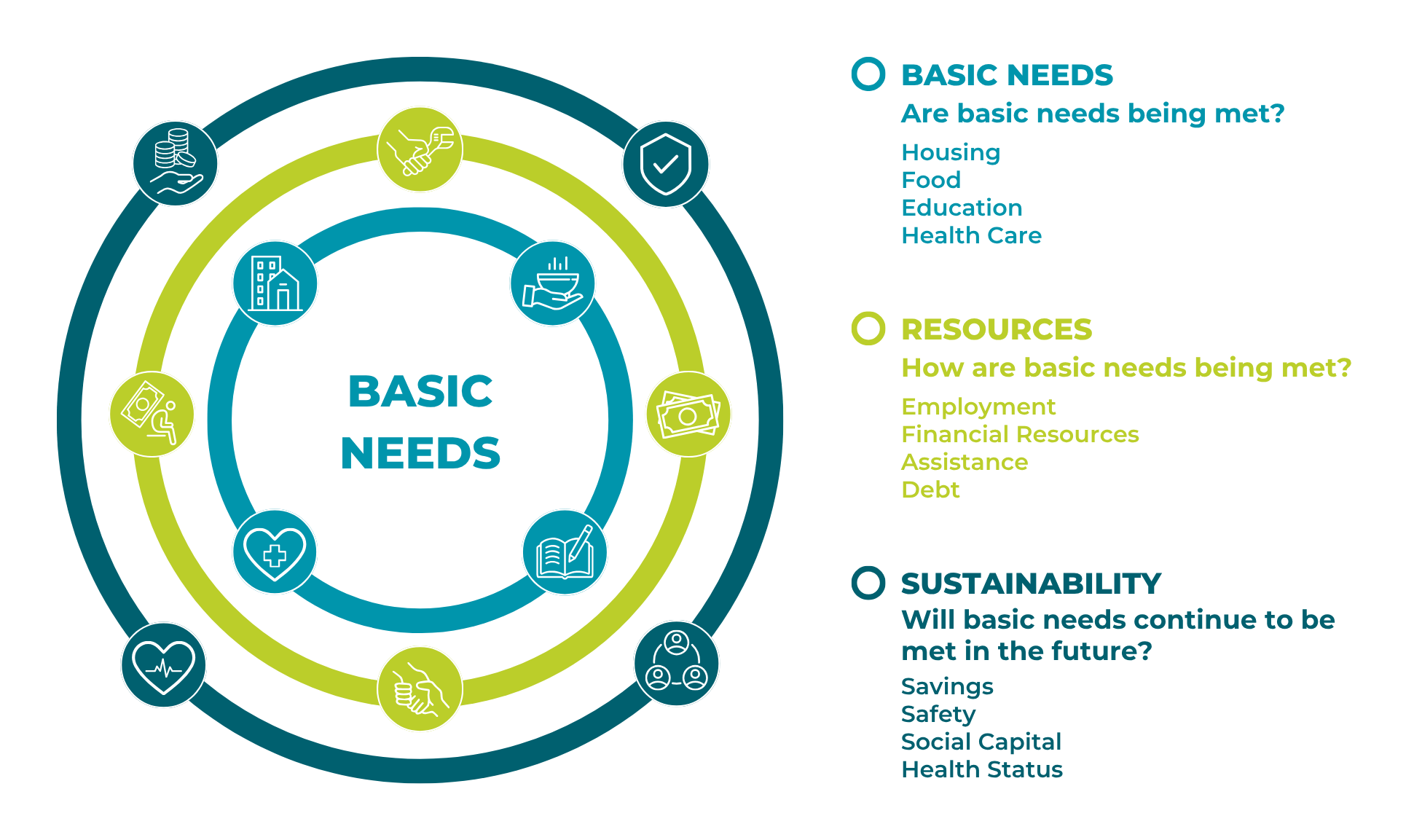
The Self-Reliance Index (SRI) contains twelve domains focused on a household’s basic needs, resources, and sustainability. Domains measure conditions and assets that increase the likelihood that refugees will be able to continue meeting their needs in the future.
The Self-Reliance Index (SRI) is a tool developed by the Refugee Self-Reliance Initiative (RSRI) to measure how close a refugee or migrant household is to becoming self-reliant. It assesses 12 domains of everyday life, including housing, food security, education, health, employment, savings, debt, personal safety, and social capital. Each domain is assigned a score indicating whether the household is in crisis, stabilizing, or on the path toward sustainable self-reliance.
This study created a bridge between the two frameworks. While the Inclusion Pentagon measures what institutions do, the SRI measures what households achieve. By linking the two, we were able to answer a question that neither tool can address on its own: Which institutional barriers are preventing refugee and migrant households from progressing toward self-reliance? For example, if a local government lacks a referral pathway for victims of xenophobia (Barrier B5 of the Inclusion Pentagon), that is likely to show up as a lower score in the SRI's Safety domain. Likewise, if entrepreneurship programs are not accessible to people holding a Temporary Protection Permit (PPT) (Barrier B3), progress in the Economic Resources domain of the SRI may be limited. This connection is not merely conceptual—it is the study's methodological backbone.
The methodology in practice
With these two tools in hand, we designed our analysis around three pillars:
Pillar A examined Bogotá's district-level regulatory framework, including mayoral decrees and City Council resolutions, with particular attention to Decree 600 of 2023, which establishes the city's comprehensive migration policy.
Pillar B analyzed the sectoral plans of seven district government agencies: the Secretariats of Social Integration, Health, Education, Economic Development, Habitat, Government, and Women.
Pillar C reviewed the Local Development Plans of five districts selected for their large migrant populations: Kennedy, Suba, Engativá, Bosa, and Ciudad Bolívar.
In total, we coded more than 50 policy documents, assessing each one against every institutional barrier identified in the Inclusion Pentagon. The difference between scores at the central government level and those at the local level is what we call the Coherence Index—a practical measure of what is lost between what public policy promises and what is ultimately delivered on the ground.
What we found at the central government level
At the central government level, Bogotá has a strong institutional framework. Decree 600 of 2023 establishes a comprehensive migration policy, and the Secretariats of Social Integration, Health, and Education have developed plans that include actions specifically targeting migrant populations. The district's regulatory framework received an average score of 1.27 out of 2.0—well above the midpoint, reflecting a genuine institutional commitment. Yet one critical gap remains: no clear pathway has been designed to help migrants move from receiving assistance to achieving self-reliance. Migrants can access the social protection system, but no active institutional strategy supports their transition from dependence to autonomy. In SRI terms, the Assistance domain is in place—the problem is that it has no exit pathway.
The local-level findings and an operational paradox
Kennedy—the district with Bogotá's largest migrant population and home to the city's main migrant service center, CEDID—received a score of 0.52 out of 2.0 in its Local Development Plan. In other words, less than half of what is established at the central level is effectively reflected in local implementation. The pattern we identified is not one of insufficient political will. Kennedy's Local Development Plan embraces a universal approach, stating that its services are intended for “the entire population.” Yet, in practice, application forms often require a Colombian national ID card.
In the areas of housing and legal identity, the score was 0.0—a complete absence of measures addressing the housing realities faced by migrant populations, despite the fact that 37% of Bogotá's migrant population lives in severely overcrowded conditions.
Perhaps the most revealing paradox is that some application forms issued by the same local government do accept the Temporary Protection Permit (PPT), while others—for vocational training programs or cash transfer benefits—do not. The technical capacity for inclusion already exists. The challenge is that it has not been applied consistently. Universal policies without operational adjustments ultimately result in de facto exclusion.
What this means and where we go from here
Our recommendations focus on three key areas:
First, Decree 600 of 2023 must be translated into consistent documentation requirements across all public programs, with the Temporary Protection Permit (PPT) recognized without exception.
Second, the District Secretariats should establish an active graduation pathway so that assistance serves as a bridge to self-reliance rather than an endpoint.
Finally, Local Governments must better align their development plans with the city's policy framework, because declaring services to be universal cannot substitute for the operational adjustments that the realities of migration demand.
This research was made possible through the support of the Refugee Self-Reliance Initiative (RSRI)’s 2026 RLO-Led Insights Fund. Bogotá was our first case study in Colombia, and for that very reason it leaves us with an important question: What would we find if we applied the Inclusion Pentagon in Medellín, Cali, Barranquilla, or Cúcuta?
The self-reliance of refugees and migrants does not depend solely on their own efforts. It also depends on institutions working in a coordinated way. Measuring that coordination is the first step toward improving it.