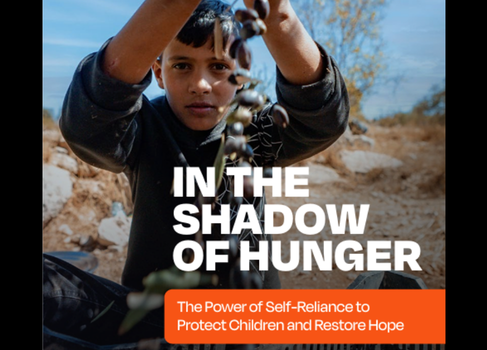
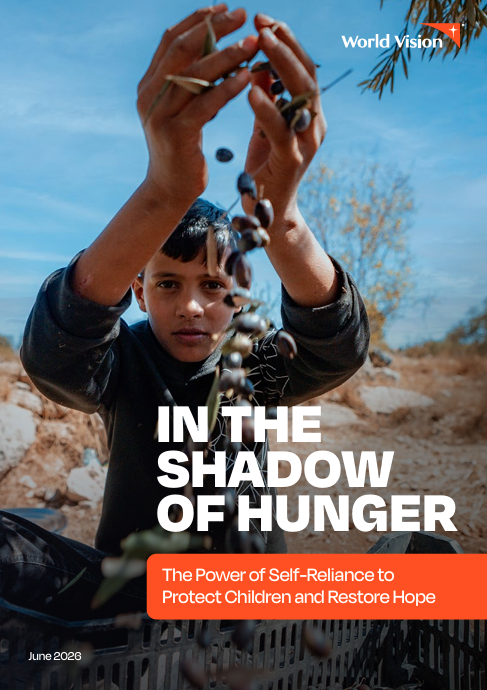
During World Refugee Week, the Refugee Self-Reliance Initiative (RSRI) welcomes the release of In the Shadow of Hunger: The Power of Self-Reliance to Protect Children and Restore Hope, a new report by World Vision International (WVI), in partnership with the World Food Programme (WFP).
The report uses the RSRI’s Self-Reliance Index (SRI) tool to examine the relationship between household self-reliance, food insecurity, and child well-being across eight countries. Developed by the RSRI through a multi-stakeholder process, the SRI is a holistic tool that helps humanitarians and their organizations to understand how refugee and displaced households are doing across multiple dimensions of their lives, including housing, food, education, health, safety, employment, financial resources, assistance, debt, savings, and social capital.
“We elected to use the SRI as a comprehensive, validated, and easy-to-use tool for measuring self-reliance across multiple domains. This allowed our findings in our report, In the Shadow of Hunger, to contribute to a larger body of research on the topic and gave us a clearer picture of how families are progressing toward greater independence,” said Amanda Rives, Sr. Director, Humanitarian Policy, Advocacy, and Partnerships at World Vision International. “By doing so, we can generate insights that not only inform our own programmes, but also help strengthen the broader evidence base on what supports refugee self-reliance and long-term well-being.”
WVI’s use of the SRI in this study is an important example of how self-reliance data can help generate evidence across sectors. The report shows that self-reliance is not only about livelihoods or income, but is closely connected to whether children eat, remain in school, stay with their families, and are protected from harm.
The findings are sobering. Drawing on nearly 3,500 household surveys across eight WVI countries of operation and including an additional 32 focus group discussions and 45 key informant interviews, the study documents how cuts in assistance and rising food insecurity are pushing families into increasingly harmful coping strategies. Children are among those bearing the greatest costs, through hunger, disrupted education, the presence of child labor and child marriage, and family separation.
At the same time, the report finds that higher levels of household self-reliance are associated with lower risks of several harmful outcomes for children, including begging for food or money, leaving school to work, child marriage, and family separation. It also finds that higher self-reliance is associated with decreased frequency of household food insecurity.
“This report demonstrates why multidimensional self-reliance data matters. WVI’s use of the SRI helps show how self-reliance is not separate from protection, food security, education, mental health, or child well-being. It is connected to all of them. Self-reliance requires rights, services, livelihoods, policy change, and sustained investment,” said Francisca Vigaud-Walsh, Executive Director of the RSRI.
Measuring self-reliance across multiple domains helps practitioners, policymakers, and funders better understand what households need, what barriers they face, and where programs and policies can support more stable and dignified futures.
The report also underscores an equally important point: self-reliance cannot be understood as a substitute for humanitarian assistance. Refugee and displaced families cannot be expected to become self-reliant when they are often denied the right to work, freedom of movement, documentation, access to education, social protection, financial services, functioning markets, and basic services. Self-reliance of refugees and other displaced persons is possible only through focused policies, integrated/holistic programming, and sustained support and measurement of the long-term impact of this support by assessing client self-reliance before, during, and after interventions close.
This is especially urgent in the current funding environment. As humanitarian resources shrink, there is a real risk that self-reliance language could be misused to justify premature reductions in assistance. The WVI report points in the opposite direction. It shows that support for self-reliance must be intentional, adequately resourced, and grounded in evidence about what families need to move from crisis coping toward greater stability, safety, and dignity.
The RSRI commends WVI and the WFP for bringing forward this important evidence and for centering the voices and experiences of children and families affected by displacement, hunger, and declining assistance.
During World Refugee Week, the message is clear: supporting refugee self-reliance is not only a long-term development objective. It is central to protecting children, strengthening families, and building more effective humanitarian, development, and policy responses.
___________________________________________________________________________________________
For more information related to the RSRI and or the SRI, please contact Shelby Quackenbush, Communications Manager: quackenbush@refugeeslefreliance.org
About the RSRI
The Refugee Self-Reliance Initiative is a global multi-stakeholder initiative working to advance opportunities for refugees and other displaced people to achieve self-reliance and live with greater dignity. The RSRI is a strategic initiative of RefugePoint and was co-founded by RefugePoint and the Women's Refugee Commission. The RSRI brings together humanitarian and development practitioners, researchers, policymakers, funders, and refugee-led organizations to strengthen evidence, improve practice, and support policy change. The RSRI developed the Self-Reliance Index (SRI), a multidimensional household-level tool used by organizations to better understand, measure, and support self-reliance across displacement contexts.