A Work Permit Is Not Self-Reliance: Reflections from the Thailand–Myanmar Border on the Meaning of Safety

By Su Myat Thwe
Partnerships and Research Coordinator | Refugee Self-Reliance Initiative
A work permit is a milestone, but it is not self-reliance. As Thailand approaches the first anniversary of its landmark refugee work permit reform this month, policymakers, practitioners, and refugee communities alike have an opportunity to reflect on what economic inclusion truly means and what social protection challenges still remain to enable refugees to live with safety and dignity.
NOTE: For readability, this article uses the term "refugee" throughout. In Thailand's official policy framework, the relevant term is "displaced persons." The terminology used here is descriptive and should not be understood as implying a particular legal status.
This World Refugee Day, the slogan “Until everyone is safe” felt more like a question than a celebration. Are we measuring the right things?
As governments and humanitarian actors search for solutions to protracted displacement amid shrinking aid budgets, there is a growing risk of equating refugees' access to work with genuine safety, dignity, and long-term security. Throughout June, I kept hearing the same tension. Thailand's landmark Cabinet resolution of August 26, 2025, marked an important breakthrough, allowing refugees to work formally for the first time. Yet nearly a year later, safety is still being imagined too narrowly, centered on a temporary work permit rather than on the interconnected legal, social, and economic conditions that enable displaced households to live with dignity.
A work permit is a milestone, but it is not self-reliance.
When Economic Inclusion Is Ambiguous, Safety Becomes Conditional
Since last October, when the Royal Thai Government's employer-bound work permit policy took effect for the refugees living in camps along the Thailand–Myanmar border, more than 5,000 refugees have entered the formal workforce through the Department of Employment. Thailand has rightly been praised for this landmark step, particularly in a region where most host countries are not signatories to the 1951 Refugee Convention. These are real gains, and I welcome them. But the story we tell needs nuance, and how we interpret this moment matters. If we mistake access to work for genuine inclusion, what appears to be a durable solution for refugees in Thailand may instead become a more efficient form of containment.
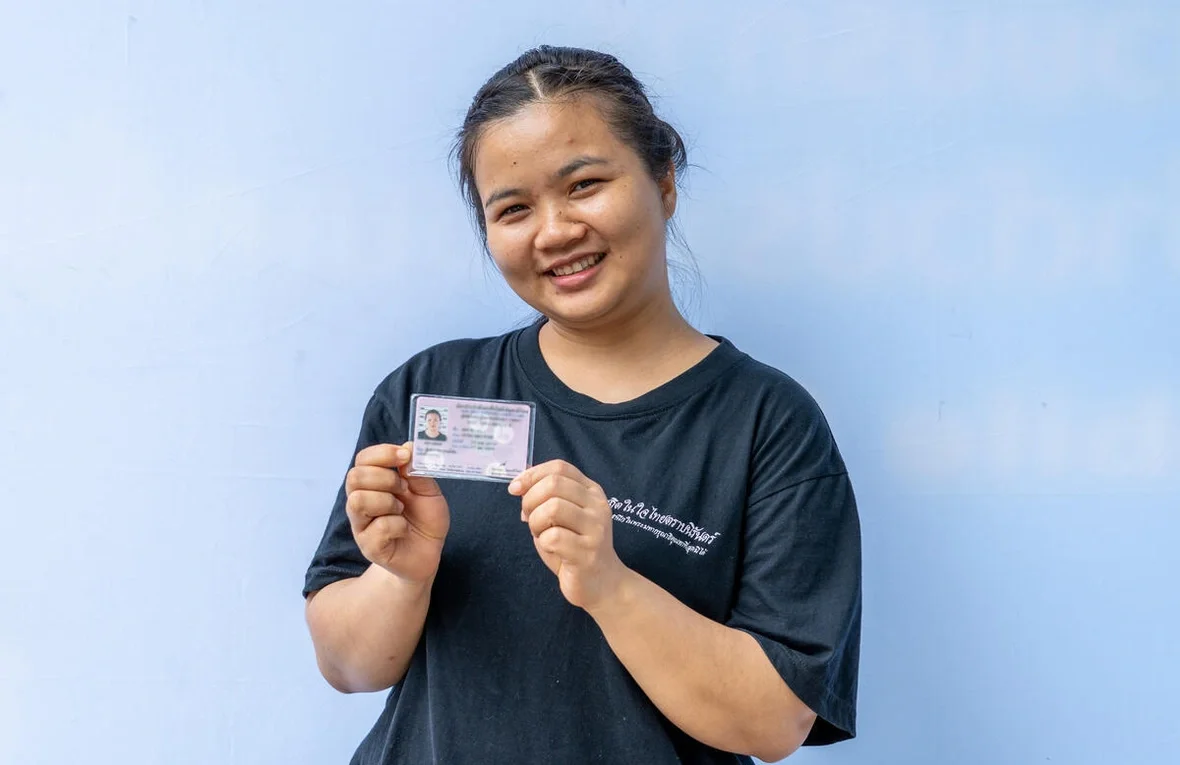
Naw Aung Shaw Paw, a refugee from Myanmar living in Ratchaburi, Thailand, displays her new government-issued identity card.
Photo: UNHCR/Apipar Norapoompipat
Only this June did the Department of Provincial Administration begin issuing non-Thai identity cards to camp-based refugees from Myanmar, many of whom have lived much of their lives without official recognition. These cards, which identify their holders as “Myanmar Displaced Persons,” are valid for ten years and grant limited freedom of movement within designated provinces. In other words, the “right to stay” followed the “right to work.” In that sense, the familiar critique may apply: The [work permit] policy appears to have “put the cart before the horse.”
In practice, the one-year work permit pilot was introduced before refugees were systematically integrated into Thailand’s civil registration system and granted access to basic financial and communication services. Ambiguity also remains over two crucial questions: What legal protection against refoulement, if any, accompanies the new identity cards? How much flexibility will refugees have to change employers, sectors, or locations over time? Until those questions are answered, economic inclusion remains partial, and safety remains conditional.
NOTES:
“Camp” refers to “temporary shelter,” the official term used by the Royal Thai Government. Nine such shelters currently operate along the Thailand–Myanmar border.)
The terms "right to stay" and "right to work" reflect the policy language of the Operations Center for Displaced Persons (OCDP) of the Ministry of Interior, Royal Thai Government, and are used here as descriptive shorthand.
When Income Becomes the Measure of Self-Reliance, Safety Disappears
The danger lies in the tendency to equate the introduction of a "right to work" with genuine economic and legal security. Such an interpretation suggests that refugees can now support themselves and that a shrinking humanitarian system can begin to move on.
The logic is understandable. When aid budgets collapse, emergencies multiply, resettlement pathways narrow, and returns are increasingly made under duress, a work permit can look like an exit. But that is precisely why this is the wrong moment to step away. I worry that we are confusing employment with self-reliance and risk measuring only the tip of the iceberg.
A work permit reaches a worker. It does not reach a household, and it certainly does not reach a village. These protracted camps in Thailand, like their counterparts elsewhere, function as village ecosystems, with markets, clinics, schools, playgrounds, and places of worship, alongside their own systems of community governance, customary justice, and communal care. Policy, however, treats them as pools of manual labor.
In practice, this mismatch creates structural exclusion. Older people, children, people living with illness or disability, and the caregivers who hold households together all fall outside a definition of self-reliance built around formal employment. The pilot has already exposed the limits of this approach: the jobs on offer are located far from the camps, skills developed in preparation for resettlement go unrecognized, and workers become separated from the community networks on which they and their families depend and to which they also contribute. It is little wonder that some young refugees describe themselves, with a sense of hopelessness, as “guinea pigs in an experiment.”
This is also why how we measure self-reliance matters. Based on information available so far, UNHCR's “50 by 35” target considers a refugee self-reliant once household consumption, excluding humanitarian assistance, exceeds the host country's poverty line. My concern is not the target itself, but how it may be interpreted. In a climate of shrinking humanitarian budgets, there is a real risk that no longer being aid-reliant becomes synonymous with being self-reliant, reducing a complex socio-economic reality to a single poverty-line benchmark.
Such a measure alone cannot capture the realities of families split between camps along the border and workplaces hundreds of kilometers away in other parts of Thailand; of working-age adults whose principal contribution is unpaid care work; or of a single income stretched across several dependent relatives. Nor can it measure the erosion of community-based protection, the absence of legal rights to build a safe home, or the simple fact that alleviating hunger is not the same as achieving security. My fear is that these metrics will be interpreted as evidence that once people can earn, support can safely fall away.
Yet for people in these camps, safety is communal before it is anything else. That is precisely what the gradual closure of the camps threatens to dismantle and what an employer-bound work permit cannot replace.
When refugees I know who study outside the camps return for holidays or holy days observed by the camps' largely Christian population and often-forgotten Muslim minority, they are not simply returning to a displacement site. They are going home. Soon, there may be no such home to return to, while a new one remains far out of reach.
“No one is safe until everyone is safe” is not a slogan to me. It describes how safety here completely depends on staying together and carrying one another through each Sisyphean stage of displacement.
NOTE: Quotes and attributions are based on the author's ethnographic field observations and interviews with refugee youth.
Why the Coming Decade Belongs to Social Protection
If the camps are to close gradually over the next decade—dismantling the community safety net that has sustained refugees for generations— those ten years should not be treated as a countdown to self-reliance before aid ends. They should be treated as a transition period to build the public systems that can replace humanitarian assistance with lasting protection. The danger is not that aid will recede, but that it will do so before social protection is in place.
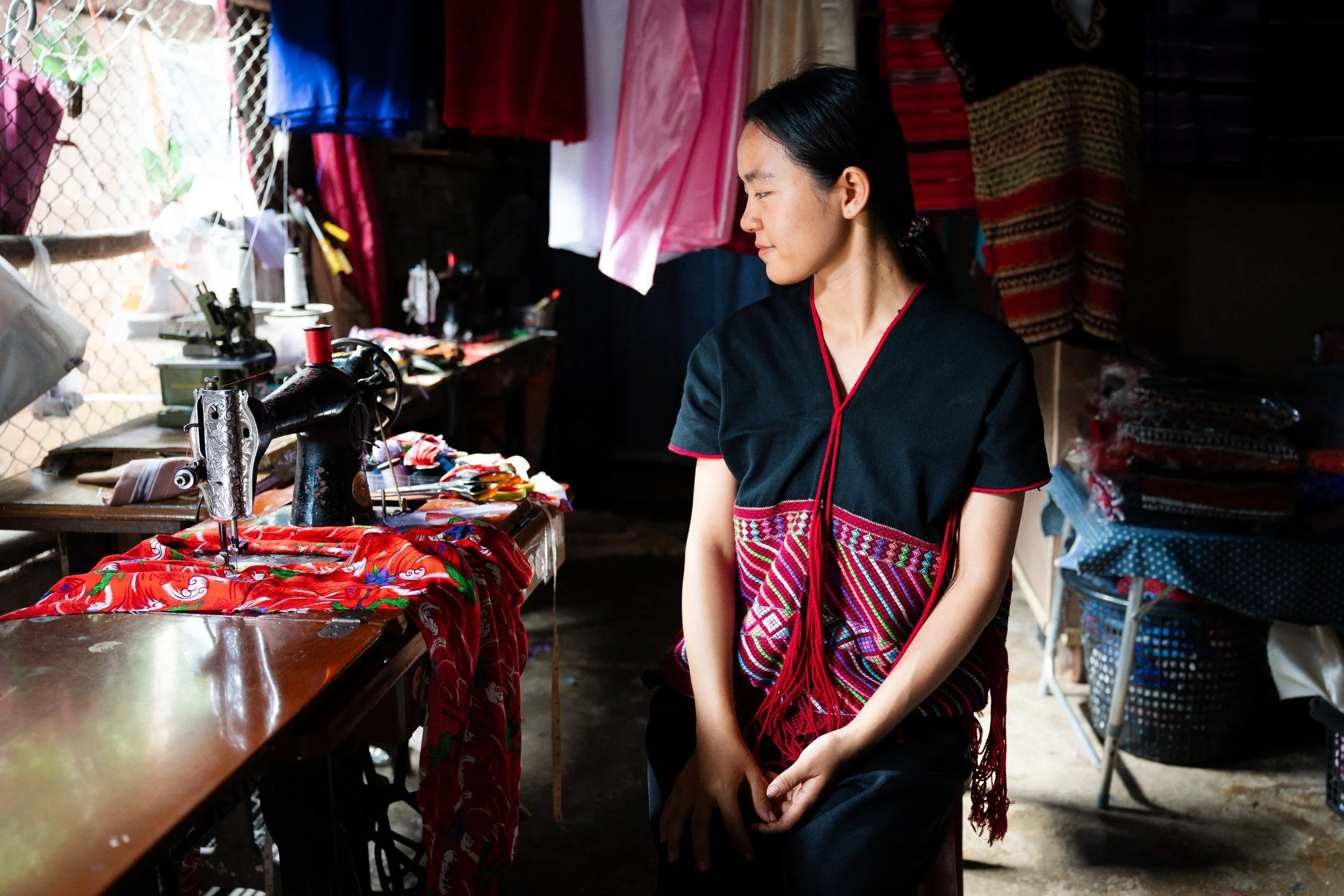
Hay Ma is a tailor who makes a living by weaving traditional Myanmar clothing from her home in Tham Hin Refugee Camp, Thailand.
Photo: RefugePoint/Chris Jensen
This is where safety and dignity stop being abstractions. A work permit reaches the person who can work; social protection reaches the household. It protects the older person, the child, the person living with illness or disability, and the caregiver whose unpaid labor makes another person’s employment possible. Refugees themselves consistently identify two priorities for this transition: health and education. That means expanding migrant health insurance to include refugee households and strengthening the Education for All framework with clear pathways into formal schooling and recognized accreditation for young people.
Dignity is not produced by income alone. It depends on whether, as aid recedes, people can rely on functioning health systems, quality education, and equitable social protection. Building and strengthening those systems is slow, often unglamorous work. It requires coordination between seasoned humanitarian actors and under-resourced government institutions—the kind of long-term investment that development funding is built for, but emergency budgets are not.
A work permit may provide employment and begin the journey toward self-reliance, but only social protection can sustain it.
Beyond Thailand: A Test for Every Host Country
Thailand's work permit policy deserves recognition. It demonstrates that even countries outside the 1951 Refugee Convention can expand refugees' access to formal employment. Yet this progress also exposes a dilemma that extends far beyond Thailand. The temporary design of both the right to work and the right to stay reflects a policy framework still anchored in the expectation that voluntary repatriation remains the primary durable solution, even as governments respond to stalled resettlement, shrinking humanitarian assistance, and domestic labor shortages.
This challenge is not unique to Thailand. From Türkiye, Egypt, Jordan, and Lebanon to Colombia, Bangladesh, and Malaysia, host countries are grappling with the same challenge: How do you govern displacement that is expected to be temporary but lasts for decades? That contradiction should not become a reason to delay the long-term investments that protracted displacement demands. If anything, it makes them more urgent, as humanitarian funding contracts and responsibility increasingly shifts to national systems that are often already overstretched.
Refugee inclusion should therefore be viewed not simply as a means of reducing humanitarian costs, but as an opportunity to strengthen shared public systems. Thailand's experience challenges us to ask whether host countries are building the institutions that make economic inclusion sustainable: schools that carry children through education, health systems that include refugee households, financial services that enable families to plan for the future, and legal frameworks that provide security while displacement endures. Without those foundations, today's temporary arrangements will risk becoming tomorrow's protracted crisis.
That is why Thailand matters beyond Thailand. If this moment becomes a decade of system strengthening rather than emergency management, its work permit initiative could serve as a model for transforming economic inclusion into genuine self-reliance. If social protection remains the missing bridge between humanitarianism and development, however, history risks repeating itself—not inside camps, but through another generation living in permanent temporariness.
This is the conversation the Refugee Self-Reliance Initiative (RSRI) will bring to a regional convening in Bangkok this October. How can self-reliance be built in a region where most host countries have not signed the 1951 Refugee Convention? Refugees themselves often begin with a different question: Not with “Can we work?” but with “Can we live with safety and dignity?”
As Thailand's one-year work permit pilot approaches its conclusion, refugees are asking what comes next. Their question is the same one that opened this essay. If self-reliance is measured only by the ability to work, we will have answered the wrong question. The real measure is whether people have the conditions to live safely and with dignity, protected enough to build a future rather than simply survive the present.